The Zaanse Schans is compact enough to walk end to end in ten minutes, which is why almost everybody sees half of it. The problem is not distance and it is not signage. It is that one green timber building looks like the next until somebody tells you which is the 1658 bakery and which is the paint mill that has been grinding pigment since 1664.
What follows is the order that works, and three versions of it sized to the time your tour actually gives you.
Where does the walk start?
Wherever you arrive, and that is worth knowing before you plan anything.
Bus 800 and the car park both put you at Schansend, the south end, beside the Zaans Museum and the information desk. The train leaves you at Zaandijk – Zaanse Schans, about 15 minutes away on the far bank, so you cross the Julianabrug and arrive at the north end with the whole mill row laid out in front of you. Guided days park at Schansend and walk you in with the bus.
The south arrival is better for the free things, which are close to it. The north arrival is better for the photograph. Getting there has the fares and the times for both.
What order should you walk it in?
South to north, and left before the dike. Specifically:
- In past the Zaans Museum at Schansend.
- Left along Zeilenmakerspad: the Catharina Hoeve cheese farm at number 5, the bakery museum at 4, the Weaver’s House at 8.
- A minute inland to the Kraaienest for the clog workshop at 4 and the liqueur distillery at 3.
- Out onto the Kalverringdijk and north with the water on your left.
- Past De Huisman at 23, De Kat at 29, De Zoeker at 31, Het Jonge Schaap at 31a and De Bonte Hen at 39.
- Then either back the way you came, or on along the polder path where the crowd stops.
Two free things come early in that order, which matters when the clock is against you, and you finish at the quiet end. Reverse it from the station and you meet the mills first, which is better for photographs and worse for timing.
What can you reach in forty-five minutes?
The stop most of the four-village coach days give you. Enough for one thing done properly and not two.
- The Kalverringdijk as far as De Kat and back. That is the photograph.
- The Catharina Hoeve cheese demonstration, which is free and runs continuously.
- Nothing indoors beyond that. Do not start a mill: the climb, the look round and the way down is twenty-five minutes and you will spend the rest of the stop watching the coach.
What can you reach in ninety minutes?
Comfortably the whole outside of the village, plus one interior.
- The dike end to end, past all five mills that stand on it.
- The cheese demonstration and the clog workshop, both free, about twenty minutes each.
- One windmill — De Kat at €7.50, about twenty-five minutes including the climb.
- Ten minutes for the bakery or the shops on the way back.
This is the version most visitors should aim for, and it is what a half-day guided tour with two hours on the ground delivers with room to spare.
What can you reach in two and a half hours?
The point at which the museums become possible.
- Everything in the ninety-minute list, unhurried.
- One museum: the Zaans Museum takes an hour, the Windmill Museum and Museum Zaanse Tijd about forty-five minutes each.
- Or a second mill instead — Het Jonge Schaap, the sawmill, is the one to pick.
- The polder path beyond the last mill, which is where the coaches stop and the view opens over water and grass with the whole row behind you.
What each stretch of time reaches on the ground
| Time | The dike | Free demonstrations | One mill | A museum |
|---|---|---|---|---|
| 45 minutes | Half of it | One | No | No |
| 90 minutes | End to end | Both | Yes | No |
| 2 hours | End to end | Both | Yes | Possible |
| 2h30 | End to end plus the polder path | Both | Yes | Yes |
Where does the route start if you arrive by train?
At the other end, and it changes the order. From Zaandijk – Zaanse Schans you walk about 15 minutes down to the water and over the Julianabrug, arriving at the north end of the Kalverringdijk with the whole mill row in front of you.
Walk it south instead: De Bonte Hen first, then Het Jonge Schaap, De Zoeker, De Kat and De Huisman, and finish at the Kraaienest and the Zeilenmakerspad for the clog workshop and the cheese farm. You get the photograph in the first two minutes rather than the last ten.
The trade-off is timing. The two free demonstrations are now at the far end from where you started, so leave time for them rather than discovering them with ten minutes to spare.
Which mill should you go inside?
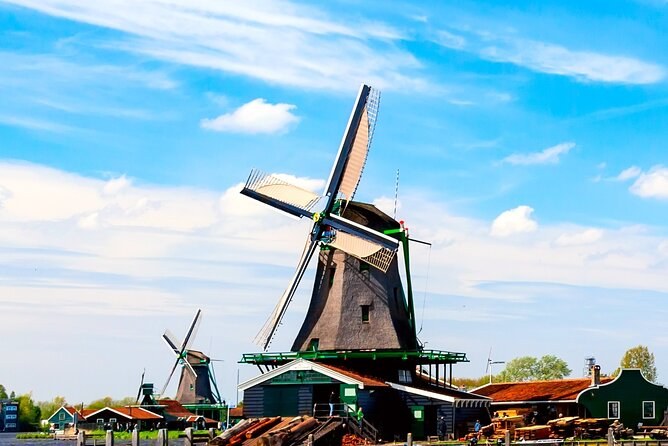
De Kat, and it is not close. It is the only working paint mill in the world, it has milled pigment since 1664, and what happens inside is a business rather than a display — chalk and pigment ground for artists and restorers who buy it. When the stones turn you feel the building move.
Het Jonge Schaap is the alternative and the answer if stairs are a problem: it is the one mill here a wheelchair can enter, and its story is as good — a 1680 sawmill demolished in 1942 and rebuilt in 2007 with 17th-century methods. The windmills page has all eleven.
What is worth stopping for that is not a mill?
Three things, and all of them are free.
The clog workshop on the Kraaienest, where a block of poplar becomes a shoe in about four minutes, with a shoe museum behind it holding one of the largest clog collections in the country. The Albert Heijn Museum Shop at Kalverringdijk 5, the grocery the 21-year-old Albert Heijn took over in 1887, with its original fittings. And the Catharina Hoeve, where the cheese demonstration runs in ten languages and the tasting costs nothing. The attractions page has every one with its address.
Where are the toilets and the food?
Toilets at the De Bezem building by the main entrance, on the Schipperplein and on the Kalverringdijk. €1 a visit, cards only, no cash — carry a card.
Food is the pancake restaurant on the water, the 1658 bakery museum selling Duivekater, and the cafe at the Zaans Museum. Almost no guided day includes lunch, and the free cheese tasting is more substantial than most people expect.
Is any of it uphill?
Nothing. The whole site is flat, mostly gravel and brick, with wooden footbridges over two of the ditches. The only climb is the stair inside a mill, which is steep, narrow and closer to a ladder than a staircase, and there is no lift in any of them.
Step-free bridges and accessible toilets are at De Bezem and the Zaans Museum, and a wheelchair can be reserved at the museum. Visitor information has the detail.
What is worth the extra walk?
Two things sit outside the six hundred metres. The polder path carries on past the last mill into open fields, and it is where the coach parties turn back. And directly across the Zaan, by the pedestrian ferry or the Julianabrug, is Zaandijk: a real village of the same green timber houses with nobody photographing them.
What is the best photograph, and where do you stand for it?
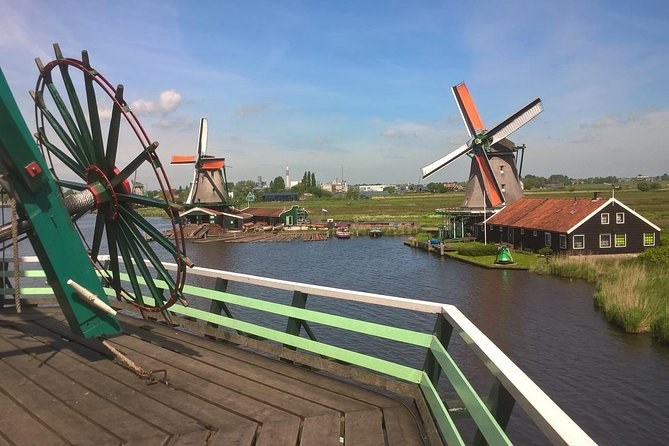
Two of them, and they are at opposite ends of the day. In the morning, stand on the Julianabrug or the north end of the Kalverringdijk and shoot south: the mill row lines up along the water with the light behind you and the polder opening to the right.
In the late afternoon, walk out onto the polder path past De Bonte Hen and turn back. The sun comes down the Zaan behind the mills, the sails are silhouettes, and there is nobody in the frame because the coaches have gone. That second one is the reason people come back.
The one to avoid is the middle of the day from the car park end, which is the busiest spot at the harshest hour. The calendar page has the hour by hour.
What can you add if you have longer than three hours?
Three things, in the order they are worth doing.
A second museum. The Zaans Museum takes an hour on its own and holds the Verkade factory floor with its original machinery still running, plus the story of Monet’s months at Zaandam. The Windmill Museum has an eleven-metre panorama of every mill in eastern Zaandam around 1800.
Zaandijk. Five minutes across the water by the pedestrian ferry or the Julianabrug, and it is the same green timber architecture with nobody photographing it. The station is there too, so it makes a natural end to the walk.
The polder. The path past the last mill runs into open fields, and twenty minutes out and back gets you the view the postcards do not use: water, grass and the whole row seen from behind.
When should you walk it?
Before eleven or after four. The coaches from Amsterdam land in the middle of the day and the dike genuinely fills between eleven and three in summer. Early gives you an empty path; late gives you the sun coming down the Zaan behind the mills.
Zaanse Schans windmill tours that leave Amsterdam at eight are on the ground inside the good window, which is the single most useful thing a guided day does here. Zaanse Schans Tours says which ones do, and the calendar page has the hour, the day and the month.