Three things go wrong before anybody arrives at the Zaanse Schans. People buy a ticket for a place that does not sell one. People book a day that gives them forty-five minutes and expect to climb a windmill. And people come at noon in July, when every coach in North Holland is parked at Schansend. All three are avoidable in about five minutes of reading.
Do you need a ticket for the Zaanse Schans?
No, and it is the single most useful thing anybody can tell you. The Zaanse Schans is a freely accessible heritage village. There is no gate, no admission ticket and no entry fee — you walk in off the road and the windmill panorama costs nothing.
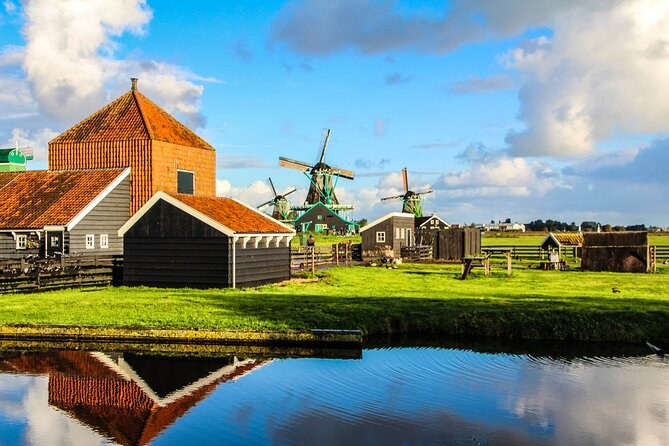
Stichting de Zaanse Schans, the foundation that runs the village, says it on its own site: it is “a famous freely accessible heritage area”. The mill row along the Kalverringdijk, the green timber houses, the polder paths — all free, at any hour.
What is not free is going inside. The Ticket Zaanse Schans is €29.50 for an adult and €20.00 for a child, and it opens seven museums and craft houses plus two mills of your choice from those open that day. Or you pay at each door: €7.50 at the paint mill De Kat, €3.50 for a child. The admission page has every published figure.
What it actually costs
Spending at the Zaanse Schans, and when each one is justified
| What | Cost | Worth it when |
|---|---|---|
| Walking in | Free | Always. This is most of the visit |
| Cheese demonstration and tasting | Free | Always |
| Clog workshop and shoe museum | Free | Always |
| Windmill De Kat at the door | €7.50 | You want to climb exactly one mill |
| Ticket Zaanse Schans | €29.50 | You are going inside three or more places |
| Car park | €15.00 | You drove. The bus avoids it entirely |
| Toilets | €1 | Card only, no cash. Budget for it |
The cheapest genuinely complete visit is a bus fare each way plus €7.50 at De Kat, and for most people that is the right answer.
Getting there from Amsterdam
Two easy ways without a car. The Zaanse Schans Express, bus route 800, runs from Amsterdam Central Station in about 24 minutes, every 15 minutes between 09:00 and 17:00, and stops beside the Zaans Museum — you step off at the entrance. Children up to and including eleven travel free.
Or take the local train to Zaandijk – Zaanse Schans, about 17 minutes from Amsterdam Centraal, then walk about 15 minutes across the Julianabrug. That arrival is better for photographs because you meet the mill row head on. Getting there has driving, cycling and Schiphol as well.
Which hour, and which day
The coaches land between eleven and three. Before eleven the village is quiet; after four they have gone and the light comes down the Zaan behind the mills.
The seasons split at April to September and October to March. High season means everything open and everyone here; low season means shorter hours, fewer doors and an empty dike. The calendar page works through month, day and hour properly.
How long to allow
This is the decision that most changes a day out, and almost nobody publishes it. The guided days from Amsterdam give you between forty-five minutes and two and a half hours on the ground.
- 45 minutes — the dike as far as De Kat and back, plus the free cheese demonstration. Nothing indoors.
- 90 minutes — the dike end to end, cheese, clogs and one windmill.
- 2 to 3 hours — all of that plus a museum, unhurried.
- Half a day — everything, with lunch, and the polder walk beyond the last mill.
Zaanse Schans ticket prices state their own figure on every card. The map page sets out what each stretch of time physically reaches.
What you will actually see
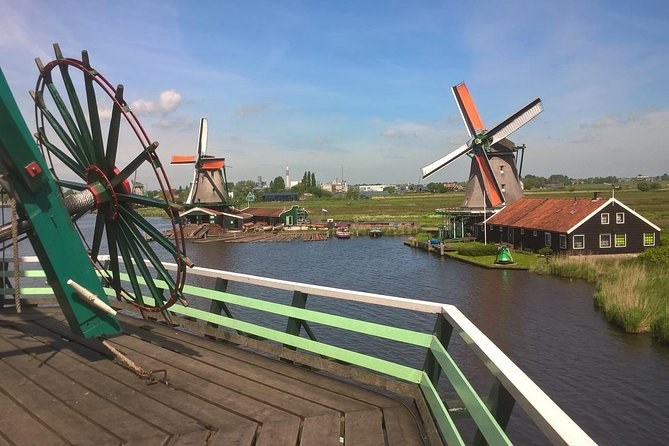
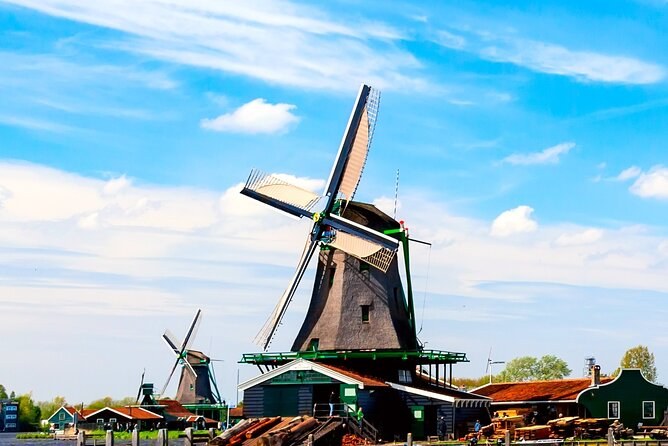
Eleven windmills stand on or near the dike and they are working machines, not scenery. De Kat has milled pigment since 1664 and still supplies artists and restorers. De Bonte Hen has pressed oil since 1693. Het Jonge Schaap is a 2007 replica of a 1680 sawmill, rebuilt with 17th-century methods, and it saws and sells timber.
Away from the mills there are six museums and five craft houses. The clog workshop and its shoe museum are free; the Catharina Hoeve gives its cheese demonstration in ten languages and charges nothing for the tasting. The attractions page has addresses for all of them, and the windmills page does the mills one at a time.
Do you need a guided tour?
Honestly, no — not to get in, because there is nothing to get into. Bus 800 solves the transport for a bus fare and the village solves itself once you are standing on the dike.
What a guided day buys is the ordering of the morning: someone who knows which mills are turning, which route beats the coaches, and which of the two cheese farms will speak your language. Two of the days here also put a windmill entry into the fare. And the full-day tours are buying something else entirely — Edam, Volendam, Marken or Giethoorn on the same ticket, with the windmills as the first stop.
The three mistakes worth avoiding
- Buying the €29.50 ticket for a two-hour stop. You will not get through seven museums in the time. Pay at one door instead.
- Booking a four-village day and expecting the mills. Those tours give the Zaanse Schans forty-five minutes to an hour and a half, which is the deal, and every card here says so.
- Arriving at noon in July with no plan. Come before eleven, or after four.
What a morning here actually looks like
You arrive at Schansend, walk past the Zaans Museum and the mill row opens in front of you across a stretch of grass and water. Straight ahead is the Kalverringdijk, six hundred metres of flat gravel path with the Zaan on one side and open polder on the other.
Most people turn left first, along the Zeilenmakerspad, because that is where the cheese farm and the bakery are and both are free. Then out onto the dike, north past De Kat, De Zoeker, Het Jonge Schaap and De Bonte Hen, with the sails going over your head. The clog workshop sits a minute inland on the Kraaienest.
The whole circuit is under a kilometre and there is not a hill on it. The only climb is the stair inside a windmill, which is steep and narrow and closer to a ladder than a staircase, and there is no lift in any of them.
What to eat, and where
Almost no guided day includes lunch, and several say so plainly in their exclusions. What is here: a pancake restaurant on the water, the 1658 bakery museum selling Duivekater — a sweet Zaanse bread — the cafe at the Zaans Museum, and a liqueur distillery on the Kraaienest with three to taste.
The cheese tasting at the Catharina Hoeve is free and is more substantial than you expect. If you are on a short stop, that plus something from the bakery is a perfectly good lunch and costs almost nothing.
Practical odds and ends
- Toilets cost €1 and take cards only, no cash.
- There is no luggage storage. None at all, anywhere on the site.
- Dogs are welcome on a lead, outdoors and in some buildings, never in the museums.
- The houses are homes. Photograph them from the path.
- Rain changes nothing. The mills and museums are indoors and the tours run anyway. The weather page has the month-by-month.
Now pick a day: Zaanse Schans Tours sets every guided visit side by side with the one number that decides it — how long you get at the windmills.