The Zaanse Schans is small enough to walk end to end in ten minutes and dense enough that most visitors miss half of it. The problem is not signage. It is that a row of green timber buildings looks like a row of green timber buildings until somebody tells you which one is the 1658 bakery and which is the paint mill.
So: in walking order, starting where the bus and the car park put you.
Schansend — where you come in
Zaans Museum and the Verkade Experience
Schansend 7, and the first building you meet. The collection of the Zaan food industry, with the original Verkade biscuit and chocolate machinery still running in the hall where the Verkade women worked. It also holds the 1871 story: Claude Monet spent several months at Zaandam and painted 25 paintings and 9 sketches of the river, the mills and the houses. Only four are in the Netherlands and one is here. Allow an hour; it is on the Ticket Zaanse Schans and it is one of two wheelchair-accessible museums on the site.
Zeilenmakerspad — cheese, bread and sails
The lane that runs left from the entrance, and the one to take first. The Catharina Hoeve is on it, and so is a bakery in a building of 1658.
The Catharina Hoeve cheese farm
Zeilenmakerspad 5. A replica of a traditional Oostzaan farm, and the stop every coach day makes. The demonstration runs in ten languages, the tasting is free, and the whole thing is a shop that makes its money when you buy. Twenty minutes.
Bakery Museum de Gecroonde Duyvekater
Zeilenmakerspad 4. An intimate bakery dating from 1658 with its original bread oven and marbled floor, given to the Zaanse Schans in 1970 and moved here from the Hazepad in Zaandijk. The Duivekater it is named after is a sweet Zaanse bread and you can eat one on the spot. Fifteen minutes, free to walk into.
The Weaver’s House
Zeilenmakerspad 8. Two families and five looms lived in this house in the 18th century, weaving the sails that drove the boats and the mills. It was a working weaver’s until the early 20th century and was rebuilt where it stands in 2015. Currently closed to visitors.
Kraaienest — clogs and liqueur
The clog workshop
Kraaienest 4, in the De Vreede warehouse of 1750, which used to store grain and snuff tobacco. Give the maker a block of poplar and there is a clog in about four minutes. The shoe museum behind the workshop is the part people do not expect: painted clogs, carved clogs, ice clogs shod with iron, horse clogs, and clogs from a dozen other countries. Both are free.
Liqueur distillery de Tweekoppige Phoenix
Kraaienest 3. Glass retorts and a copper kettle, so you can watch the whole process, and three liqueurs to taste. There is a reason a distillery belongs here: the mills ground grain for bread, for beer and for gin.
The Kalverringdijk — the mills
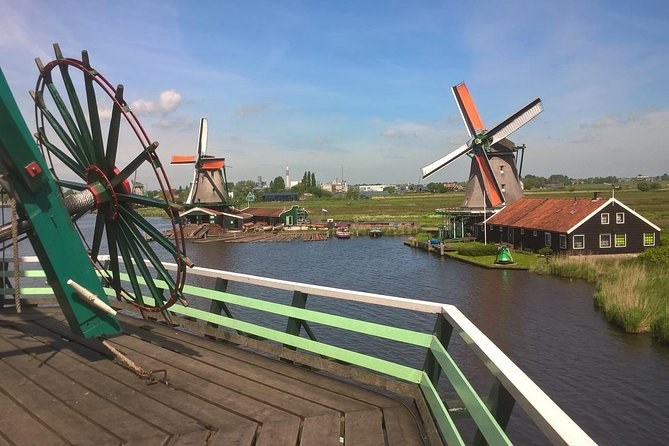
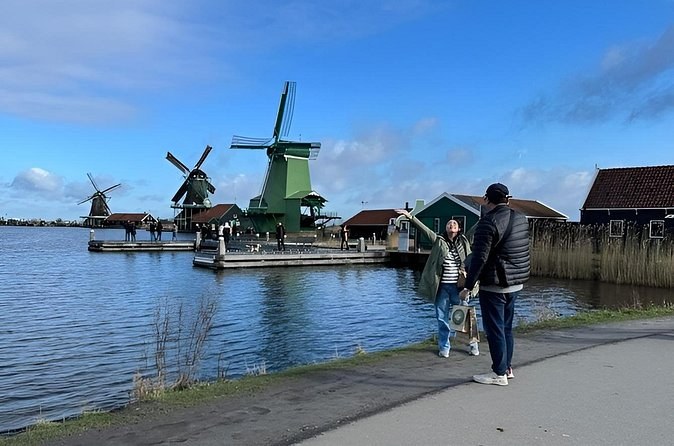
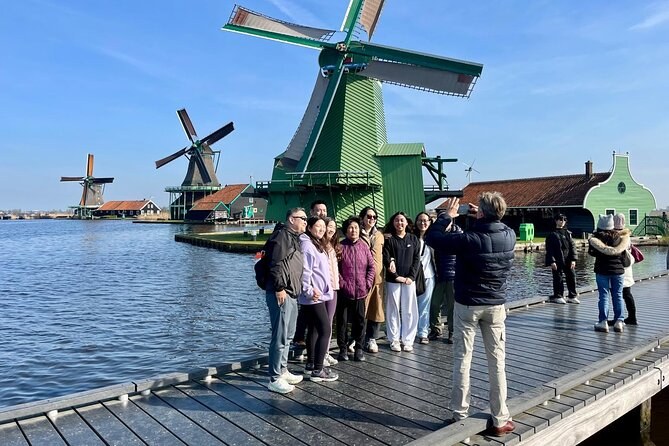
Now the dike itself, north with the water on your left. This is the six hundred metres everybody comes for, and five working mills stand on it. If you can only go inside one, make it De Kat; if the stairs are a problem, Het Jonge Schaap is the one that takes a wheelchair.
De Huisman — 1786
Kalverringdijk 23. A snuff and spice mill that since 1955 has stood on top of the 1908 spice warehouse Indië’s Welvaren; three pairs of stones still grind tropical spices below it. The shop is free and smells extraordinary. The mill itself is paid.
De Kat — 1664
Kalverringdijk 29. The only working paint mill in the world, still milling chalk, pigment and oil for artists and restorers who buy it. When the stones are turning the whole building vibrates, which is the thing nobody warns you about. €7.50 at the door, or one of your two mills on the Ticket.
De Zoeker — about 1610
Kalverringdijk 31. An oil mill with the best relocation story on the site: it came here in 1968 with its eighteen-tonne cap moved in one piece, hoisted over railway overhead lines and then floated by boat across the Zaan. Open on Saturdays in June, July and August, and at no other time.
Het Jonge Schaap — 1680, rebuilt 2007
Kalverringdijk 31a. A six-sided over-wheeling sawmill, a shape unique among the 350-odd sawmills the Zaan once had. The original was demolished in 1942; this one was raised in 2007 using as much 17th-century method as possible. It saws and sells timber, and it is the only mill here a wheelchair can enter.
De Bonte Hen — 1693
Kalverringdijk 39, and the last of the row. An octagonal oil mill with a gallery round it that has survived multiple lightning strikes where most of the region’s around six hundred mills burned. Restored between 1973 and 1978, and it still presses oil.
Also on the Kalverringdijk, and easy to walk past
The Kalverringdijk, building by building
| Building | Number | What it is |
|---|---|---|
| Museum Zaanse Tijd | 3 | Dutch clocks, nearly all running, including pendulum clocks from the era of Christiaan Huygens |
| Albert Heijn Museum Shop | 5 | The grocer’s shop the 21-year-old Albert Heijn took over in 1887, with its original fittings. Free |
| The Noorderhuis | 17 | A merchant’s house of about 1650, its period room under restoration for the first time in sixty years |
| Blik op Cacao | 25 | A cocoa shop opposite a working cocoa factory. Two centuries of beans on this stretch of water |
| The Windmill Museum | 30 | An eleven-metre panorama of every mill in eastern Zaandam around 1800, and a model of 1,100 of them |
The mills you can see but not enter
Four more are worth knowing by name because they are the ones people photograph and cannot identify afterwards. De Gekroonde Poelenburg (1869) is a paltrok sawmill, a type the Zaan once had two hundred of, where the entire mill turns on a rolling ring rather than just the cap. Het Klaverblad is a hollow post mill built by hand between 2000 and 2005 by the miller Ru Pos, bringing back a lost type. De Os predates 1663 and lost its sails in 1916 to a diesel engine, which is the moment the wind era ended. De Bleeke Dood is the oldest smock mill still standing in the Netherlands.
Two mini-mills complete the set: De Hadel, a meadow mill moved from Midwoud in 1968, and De Windhond, the last crushed-stone mill from the Zaan region.
What to do if you only have ninety minutes
Zaanse Schans windmill tours give you between forty-five minutes and two and a half hours here, and the difference decides how much of the above you actually reach.
Every building above stands within six hundred metres of the next. Zaanse Schans Tours lists the days that give you enough time to walk it properly.