Two places in the Netherlands are famous for windmills, and the internet treats them as interchangeable. They are not. One is a village of industrial mills that made paint, timber and oil; the other is a water-management landscape that kept a region dry. Choosing the wrong one for what you want is the commonest windmill mistake in Dutch travel.
The short answer
If you are based in Amsterdam and have half a day, go to the Zaanse Schans. It is twenty minutes away, it costs nothing to walk into, and you can go inside working mills, watch a clog carved and taste cheese in the same hour.
If the landscape is the point — nineteen mills in a row across open polder, water everywhere, no shops — then Kinderdijk is the one, and it is a real journey from Amsterdam.
Side by side
The Zaanse Schans and Kinderdijk compared
| Zaanse Schans | Kinderdijk | |
|---|---|---|
| What it is | An industrial heritage village on the Zaan | A polder drainage landscape |
| UNESCO | No, and never has been | Yes, inscribed 1997 |
| Mills | Eleven, most of them industrial — paint, oil, timber, spice | Nineteen, water-management mills |
| From Amsterdam | about 24 minutes by bus 800 | About 90 minutes, with a change |
| Entry | Free to walk into | Paid site with a visitor centre |
| Also there | Six museums, five craft houses, cheese, clogs, shops | The mills, the water and the sky |
| Best for | A half-day from Amsterdam, families, a first Dutch trip | Landscape, photography, a full day |
| The catch | Genuinely touristy around the mills | Getting there, and back |
The UNESCO question, settled
The Zaanse Schans has never been inscribed on the UNESCO World Heritage List. Kinderdijk — a different windmill site, about 100 kilometres south — was, in 1997.
This matters more than a badge. Kinderdijk was inscribed for exactly what it is: the most complete surviving example of Dutch hydraulic engineering, a system of dykes, reservoirs, pumping stations and mills that drained and kept a polder. Its mills are machines for moving water.
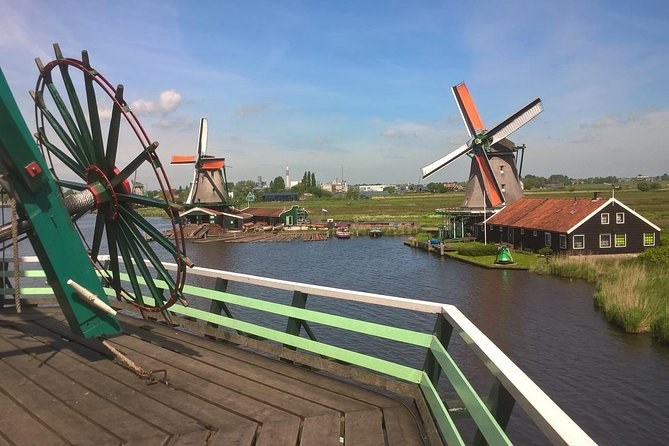
The Zaanse Schans is a different kind of place and a different kind of interesting. Its mills are factories — they sawed timber, pressed oil, ground pigment and milled spice, and the region built 26 shipyards launching between 100 and 150 ships a year on the timber they cut. It also, unlike Kinderdijk, was assembled: the buildings were moved here between 1961 to 1974. The history page tells that properly, and it is a better story than the badge.
The case for the Zaanse Schans
- You can get inside. De Kat has milled paint since 1664 and still does; you can climb its stage for €7.50 while the stones are turning.
- It is free and it is close. Bus 800, about 24 minutes, no gate at the other end.
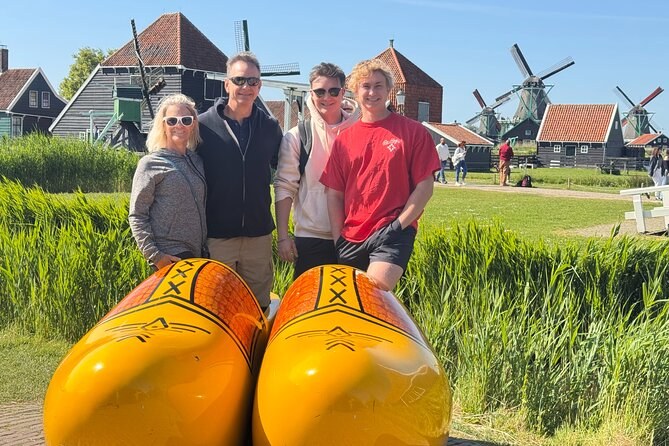
- There is more than mills. Six museums, a 1658 bakery, the first Albert Heijn shop, a clog workshop and a cheese farm, all within six hundred metres.
- It works in half a day. Which is what most people visiting Amsterdam actually have.
The case for Kinderdijk
- The landscape is the thing. Nineteen mills across open water and grass, with nothing built up around them.
- It is UNESCO-listed, and if that is on your list, it is the one.
- It is far quieter in the sense that matters: no souvenir shops in the frame.
- It is better from Rotterdam, which is where most people who go actually start.
Getting to each one
The Zaanse Schans is the easy one. Bus 800 from Amsterdam Central runs every 15 minutes between 09:00 and 17:00 and takes about 24 minutes, dropping you at the entrance; the local train to Zaandijk – Zaanse Schans takes about 17 minutes and leaves you about 15 minutes away across the bridge. Either way you are there and back inside half a day, and neither costs more than a fare. Getting there has driving and cycling as well.
Kinderdijk is a project from Amsterdam: train to Rotterdam or Dordrecht, then a bus or a waterbus, and about ninety minutes each way if the connections behave. From Rotterdam it is straightforward and pleasant, which is why almost everybody who goes starts there rather than in Amsterdam.
That difference is the whole practical argument. A morning at the Zaanse Schans costs you a fare and half a day. A day at Kinderdijk from Amsterdam costs you the day.
Can you do both?
Not in a day from Amsterdam, and it is not worth trying. They are a hundred kilometres apart in opposite directions from the city, and the second one would be a rushed hour after three hours of travelling.
If you have several days and want both, the sane plan is the Zaanse Schans as a morning from Amsterdam and Kinderdijk as a day from Rotterdam or Dordrecht, where the boat connection makes it pleasant rather than a slog.
What the Zaanse Schans has that Kinderdijk does not
Interiors, and a lot of them. Six museums, five craft houses, a 1658 bakery and the grocer’s shop the Albert Heijn chain grew out of, all inside six hundred metres. The attractions page has every one with its address.
It also has the industrial story, which is the thing most visitors do not arrive expecting. These mills sawed timber, milled pigment, pressed oil and ground spice; the crankshaft that made industrial sawmilling possible was patented in 1594 by Cornelis Corneliszoon van Uitgeest, and what followed made the Zaan the oldest industrial region in Western Europe. Kinderdijk’s mills pumped water, magnificently, and that is a different subject.
What Kinderdijk has that the Zaanse Schans does not
Emptiness, and a horizon. Nineteen mills strung across polder and water with nothing built up around them, and no shops in the frame. If the photograph in your head is a row of mills against a big Dutch sky with nobody in it, Kinderdijk is the one that delivers it.
It also has the World Heritage inscription, which is not a small thing if you care about why a site is protected. It was listed in 1997 as the most complete surviving example of Dutch hydraulic engineering — the mills, the dykes, the reservoirs and the pumping stations, working as one system.
The verdict, by visitor
- First trip to the Netherlands, based in Amsterdam: the Zaanse Schans.
- With children: the Zaanse Schans, and take the bus.
- Photographers after landscape: Kinderdijk, on a still morning.
- Industrial history: the Zaanse Schans, and go inside De Kat.
- Collecting UNESCO sites: Kinderdijk, and know why it is on the list.
- Half a day and no car: the Zaanse Schans, without hesitating.
Zaanse Schans tickets run to the village every day of the year, and the admission page shows how little you need to spend once you are there.
Decided on the windmills twenty minutes from Amsterdam? Zaanse Schans Tours compares every guided way of getting to them.